
After 15 years as an ALS caregiver, I’m still learning from others
I’m both an 'old-timer' and a student when it comes to ALS care
Written by |

After living with my husband Todd’s ALS for more than 15 years, shouldn’t I be better at navigating this disease?
Author Malcolm Gladwell popularized the idea that mastery comes after 10,000 hours of doing something. If that’s true, then surely I should have ALS figured out by now. I’ve spent thousands upon thousands of hours taking care of Todd, finding equipment, and figuring out how to keep him alive and as comfortable as possible.
But ALS doesn’t work that way.

The truth is, we’ve only figured out how to manage the disease in the exact condition he’s in right now. When the disease progresses, I’m back to square one.
There is no mastery with ALS, because the rules keep changing. Each stage requires new skills. What worked last month might not work this month. What worked last week might not work this week. And what works for one person with ALS might not work for another at all. The disease progresses so differently for everyone.
Often, people new to the disease turn to me for advice, and I’m happy to help where I can. I can point them toward equipment that has made a difference for us. I can answer questions about getting a feeding tube or using a noninvasive ventilator. I can explain how the manual assist cough has helped keep Todd’s lungs clear.
Sometimes I’ll send a photo. I’ve shared pictures of Todd’s bed setup, showing how I attach ropes to a twin-size sheet and connect it to our overhead lift. For a long time, I was hurting my wrists every time I turned him in bed. Eventually, I figured out a way to let the lift do the work instead.
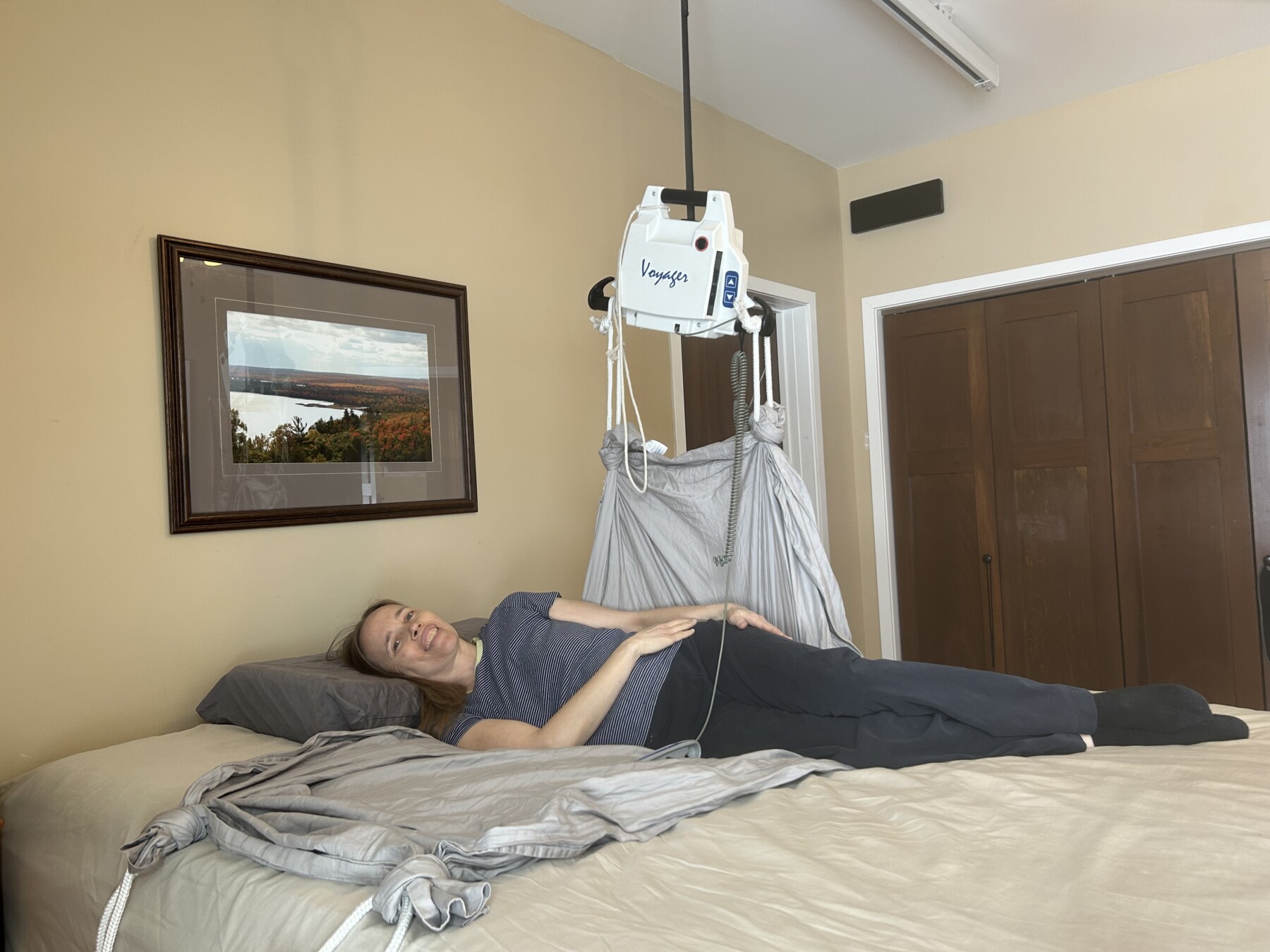
Kristin Neva demonstrates how an overhead lift can be used along with a sheet to help turn her husband, Todd. (Courtesy of Kristin Neva)
I’ve learned these things through trial and error. But when Todd enters a new stage of the disease, I search for guidance just like everyone else.
Because we live four hours from the nearest ALS clinic — which can’t provide telehealth services across state lines — we no longer attend regular clinic visits. Our general practitioner is wonderful, but she isn’t an ALS specialist. So when new challenges arise, I turn to the people who understand the disease best: other people with ALS and their caregivers.
I reach out to companions on this road through the ALS Facebook groups I belong to. Sometimes, the people guiding me have only been dealing with ALS for a few years. But their disease progressed faster, which means they’ve already learned skills I’m only now needing. In those moments, I’m the “old-timer,” yet I’m also the student.
That’s one of the strange truths of ALS. Experience doesn’t guarantee expertise. Instead, we become a community of teachers and learners, passing along what we know in the moment we know it.
None of us can master this disease. But together, we can help each other find the next step.
Note: ALS News Today is strictly a news and information website about the disease. It does not provide medical advice, diagnosis, or treatment. This content is not intended to be a substitute for professional medical advice, diagnosis, or treatment. Always seek the advice of your physician or other qualified health provider with any questions you may have regarding a medical condition. Never disregard professional medical advice or delay in seeking it because of something you have read on this website. The opinions expressed in this column are not those of ALS News Today or its parent company, Bionews, and are intended to spark discussion about issues pertaining to ALS.



Janet Fettig
Hi All! I read the beginning of this email from you and thoroughly enjoyed it! Thank you! My only sister (69) was diagnosed with Balbar onset ALS about two years ago. She has lost her speech and after losing weight (unintentional!) she just received a feeding tube a week ago at Mayo clinic in Rochester, MN where she returns every 3 mos. No more food limitations nor choking . She has a wonderful husband who has accepted what cannot be changed, helps her with everything as needed. Most recent changes have been in her arms and hands. She is still able to walk, uses a walker yet and getting an electric chair soon. We live 250 mi from them but we visit regularly. ALS is the absolute worst of worst diseases with no cure. I pray for a miracle for her and all who have this dreadful disease. I admire how you have mastered caring for your husband. Caregivers are a Godsend!!! Looking forward to your newsletter 'conversations' again soon. Thank you! JF