ALS overview
 Fact-checked by
 Amyotrophic lateral sclerosis (ALS) is a progressive neurological disorder that damages nerve cells and causes disability. The condition is also known as Lou Gehrig’s disease, after the famed New York Yankees baseball player who was diagnosed with the disorder in the late 1930s.
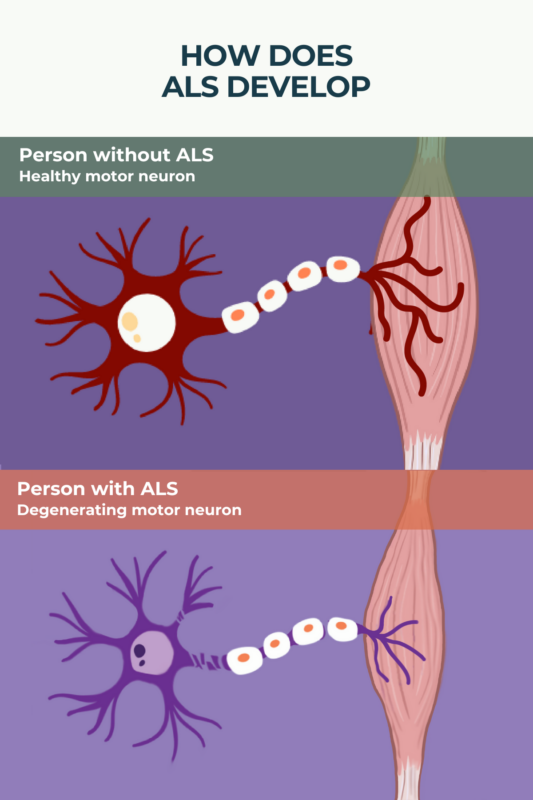
ALS specifically damages and destroys motor neurons, the nerve cells that control voluntary movements. It affects both upper and lower motor neurons, or those that run from the brain to the spinal cord, and from the spinal cord to muscles in the body. With the loss of these nerve cells, the brain is no longer able to control muscle movement, and patients progressively lose the ability to move their limbs, speak, swallow, and breathe.
Causes of ALS
ALS is caused by the progressive dysfunction and death of motor neurons, the nerve cells that control muscle movement. But exactly why this happens remains largely unknown. It is believed that multiple risk factors, including genetics, environmental exposures, and lifestyle choices, interact to drive the disease.
Genetics and other biological factors are among the contributors to ALS:
- Genetics: Mutations in dozens of genes have been linked to ALS, which can sometimes run in families. Commonly affected genes include C9ORF72, SOD1, FUS, and TARDBP.
- Sex: The disease is somewhat more common in men than in women.
- Age: ALS most often develops between the ages of 55 and 75, and very rarely in children.
Environmental and lifestyle factors that have been linked to ALS development include:
- smoking
- certain careers, particularly military service
- exposure to toxins like pesticides and heavy metals
- head injury or trauma
- exposure to electric shocks or electromagnetic fields
- excessive exercise
- certain viral infections
Ultimately, ALS causes are likely multifactorial, and researchers are still working to understand more about them.
Types of ALS
ALS is commonly classified into two main types based on whether or not a person has a family history of the disease:
- Familial ALS: This refers to the 5%-10% of ALS cases with a family history. About two-thirds of these patients have a known disease-driving mutation.
- Sporadic ALS: This refers to the 90%-95% of cases in which there is no family history of the disease. About 10% of patients have a known disease-associated mutation.
In both familial and sporadic forms of ALS, environmental and lifestyle factors are thought to interact with genetics to inform whether a person will develop the neurodegenerative disease. Symptoms are broadly comparable between the two types of ALS, although familial ALS has been associated with a younger age at disease onset.
ALS is also often classified based on the muscles it affects first:
- Limb-onset ALS: In approximately two-thirds of cases, muscles in the arms and hands, or the legs and feet, are the first to be affected.
- Bulbar-onset ALS: In a minority of patients, the first symptoms affect the muscles in the head and throat.
Other rare classifications may also be used; for example, juvenile ALS describes anyone in whom the disease develops before age 25.
ALS symptoms
The hallmark symptom of ALS is muscle weakness. This weakness generally starts off as fairly subtle, and usually affects one part of the body at first. However, as the disease progresses, it tends to become more severe and spread to other regions of the body.
In limb-onset disease, patients may first notice weakness in their hands, manifesting as difficulty writing or grasping objects, or in their feet, leading to issues walking. In bulbar-onset disease, swallowing problems and trouble with speech are usually among the earliest signs.
Regardless of its onset, ALS ultimately leads to progressive disability and paralysis, and patients have little to no ability to move voluntarily in its later stages. Swallowing, speaking, or breathing independently also usually becomes limited or impossible. Respiratory failure, where the lungs are not able to adequately supply the body with oxygen, is the most common cause of death in ALS.
Beyond muscle weakness, other possible ALS symptoms include:
- muscle twitches, cramps, spasms, or wasting (muscle atrophy)
- fatigue
- mental health issues, such as anxiety and depression
- pseudobulbar affect, marked by sudden bursts of laughing or crying
- cognitive difficulties
- digestive issues
Some people with ALS will also be diagnosed with frontotemporal dementia, a neurological condition that causes substantial changes in cognition and behavior.
ALS diagnosis
No single test can confirm an ALS diagnosis. The diagnostic workup for the disease broadly involves assessments that check for ALS-like damage to motor neurons and confirmation of ALS disease progression, combined with tests to rule out other potential causes for a person’s symptoms. It usually takes about a year from the time symptoms first appear until the diagnosis of ALS is confirmed.
Some of the diagnostic tests commonly used to assess the presence of ALS and exclude other conditions include:
- nerve conduction studies and electromyography, which check the health and function of nerves and muscles
- MRI scans, to image the brain, spinal cord, and/or muscles
- spinal tap (also called lumbar puncture), used to collect a sample of the fluid circulating around the brain and spinal cord for analysis
- blood or urine tests, to check for other potential causes of symptoms.
- muscle or nerve biopsy, in which a small piece of tissue is collected for analysis in a laboratory
A blood sample may also be used for genetic testing to identify disease-associated mutations. This is usually done for cases of familial ALS in which there is a known family history of the disease.
ALS treatment options
There is no cure for ALS, but there are three treatments approved in the U.S. that have shown the ability to slow the disease’s progression. These include:
- riluzole (Tiglutik and generics)
- edaravone (Radicava ORS and generics)
- Qalsody (tofersen), for people with SOD1 gene mutations
Beyond these disease-modifying therapies, people with ALS commonly receive other medications to manage symptoms and improve quality of life. For example, Nuedexta (dextromethorphan and quinidine) is approved for managing pseudobulbar affect in ALS.
Other nondrug interventions or supportive equipment that can be helpful for people with ALS include:
- physical, respiratory, occupational, or speech therapy
- psychotherapy and counseling
- respirators or other devices to support breathing
- feeding tubes, to ensure adequate nutrition
Doctors may recommend certain lifestyle changes, such as diet adjustments, to make living with ALS easier.
How common is ALS?
The incidence of ALS, or the number of new cases per year, is estimated to be about 2 per 100,000 people. In the U.S., about 5,000 people are diagnosed every year.
This incidence increases with age, typically starting in the 40s and increasing until about age 80. However, ALS can rarely occur at younger ages, including in childhood.
The prevalence, or the total number of people living with ALS, varies among geographic locations, but is estimated to be somewhere between 4-6 individuals per 100,000 people. The U.S. Centers for Disease Control and Prevention estimates that there are close to 35,000 people with ALS living in the U.S.
ALS life expectancy
The average ALS life expectancy is about two to five years after the initial appearance of symptoms, though the prognosis can vary depending on which symptoms appear first and how quickly they progress.
However, about 20% of ALS patients will survive more than five years after disease onset, and about 10% will survive for a decade after the disease first appears. A minority of patients, about 5%, may survive with ALS for 20 years or longer.
Living with and managing ALS
Living with ALS is challenging for both patients and caregivers. As the disease progresses, daily routines will likely need to be adjusted to help conserve energy, stay safe, and support independence for as long as possible.
Because ALS can make it difficult or impossible to move around, or swallow or speak, many people living with ALS rely on supportive equipment to help them maintain health and function in day-to-day life. This may include:
- wheelchairs or walkers
- adaptive utensils and other dining tools
- adaptive clothing or dressing tools
- communication devices
- smart electronics
- grab bars, accessible showers, and other home adaptations
Caregivers may also wish to incorporate respite care into the management plan. This can provide them with practical support in managing their loved one’s daily care, giving them time for themselves and making the day-to-day burden of managing ALS more manageable.
ALS News Today is strictly a news and information website about the disease. It does not provide medical advice, diagnosis, or treatment. This content is not intended to be a substitute for professional medical advice, diagnosis, or treatment. Always seek the advice of your physician or other qualified health provider with any questions you may have regarding a medical condition. Never disregard professional medical advice or delay in seeking it because of something you have read on this website.