
As ALS forces change upon us, I just do what needs to be done
I've developed a detachment from the emergencies I handle regularly
Written by |

My husband, Todd, was asked about his health over the Thanksgiving weekend as we caught up with some old friends.
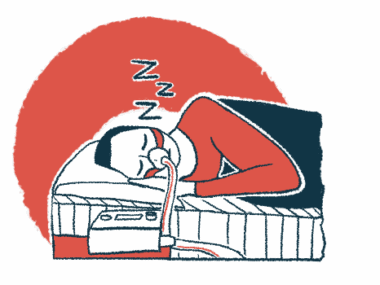
He and I explained that his breathing has been declining recently, that ALS has taken most of his lung function, and he now has to eat with his noninvasive ventilator.
“He’s been doing that for a few months,” I added. “More recently, we changed our procedure for his nightly wash-up routine, so he has his ventilator on except for a few minutes while brushing his teeth and washing his face.”
Until a few weeks ago, Todd could go without a vent for about 45 minutes while getting ready for bed. The vent stayed plugged in in the other room while I helped him in the bathroom and gave him medications and vitamins through his feeding tube. And then a nighttime caregiver brushed his teeth, washed him up, and changed his shirt.
On a few occasions, he ran out of breath mid-sentence while telling me something, and I’d grab his vent so he could fill his lungs before his nighttime caregiver took over.
‘I know what to do’
But one night, he said too much while giving instructions to his nighttime caregiver, and he lost his tidal volume while trying to speak over the hum of his suction machine. All he could do was mouth words. The caregiver realized he was saying, “Get Kristin.”
She opened Todd’s bedroom door, called for me, and said Todd was having trouble breathing. I hurried into the room and drove Todd’s wheelchair over to his ventilator cart, and I used his cough assist machine to force air back into his lungs, refilling his tidal volume. We keep an old cough assist machine that somebody had donated to us on the bottom shelf of his cart, because it works better than his noninvasive ventilator in these situations. It doesn’t require him to initiate a breath and it pushes air much more forcefully into his lungs.
In fact, it works even better than the newer machines. Todd’s respiratory therapist once brought a new machine for him to try, because it had a percussive function, which he thought might help loosen up his lungs. But it required Todd to initiate a breath for it to push air with a decent amount of force, and when Todd loses his tidal volume, he needs a machine that will blow hard exactly when he cannot initiate a breath.
After we told this story, my friend said that it must have been really scary. I thought about it before replying.
It used to be really scary, but we’ve had a number of these near-death experiences over the last five years, and I know what to do.
“I imagine I feel like someone who works in the ER,” I explained. “I know the steps to take, and if I can’t get Todd’s lungs refilled, then nothing can be done because Todd isn’t going to get a tracheotomy and an invasive ventilator.”
I’ve developed a certain detachment from the emergencies I handle on a regular basis. It’s been traumatic to face each new crisis in the beginning, but I’ve gotten more adept at responding during these crises since Todd’s lungs have weakened. Maybe someday I’ll need to process the trauma of it all, but in the moment, I do what needs to be done.
We’ve changed our nightly routine now, and Todd’s ventilator goes into the bathroom when he’s ready for bed, and he stays on it for most of his care.
Change is the only constant with ALS. Todd’s health keeps declining, and we keep figuring out new routines to hold on to life.
Note: ALS News Today is strictly a news and information website about the disease. It does not provide medical advice, diagnosis, or treatment. This content is not intended to be a substitute for professional medical advice, diagnosis, or treatment. Always seek the advice of your physician or other qualified health provider with any questions you may have regarding a medical condition. Never disregard professional medical advice or delay in seeking it because of something you have read on this website. The opinions expressed in this column are not those of ALS News Today or its parent company, Bionews, and are intended to spark discussion about issues pertaining to ALS.


Rosemary Hunter
Kristin,
What an insightful post. I am a psychiatrist and a new pALS. When I can get distance on the process we all go through--the continuous grief and adjustment with each step-wise loss--for me there is a positive sense of creativity and mastery at each step. No one can write the book on how to do all this--but I am forever grateful for those who help with this jigsaw puzzle of life. You are right that it is sort of like my medical training in the ER, where you develop the distance you need to do the work you have chosen to do. I have been an active project doer in life before ALS and would be interested in some of the adaptive technology projects Todd continues to enjoy on his computer. And, as my second arm is yielding to ALS, I'd love to hear from anyone who has found a substitute for woodworking, needlepoint, sewing, quilting or such in the adaptive world.
Kristin Neva
Todd uses a headmouse to do graphic design projects for our church and to draw using CorelDRAW and Gimp. Thanks for commenting!