
A novel helped me process heavy questions I face as an ALS caregiver
I find it helpful to read about other experiences with death and dying
Written by |

I brought “Some Bright Nowhere” by Ann Packer with me to Florida as my spring break beach read, but it wasn’t exactly light material. It’s a novel about a woman dying of cancer.
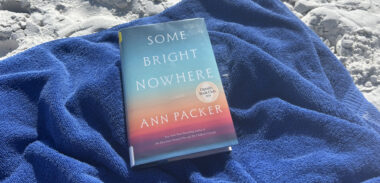
Columnist Kristin Neva’s spring break beach read was “Some Bright Nowhere” by Ann Packer. (Photo by Kristin Neva)
You’d think after nearly 16 years of living with my husband Todd’s ALS, I might want a break from anything related to illness or death. But dying and death are always on my mind, and strangely, I find it helpful — even cathartic — to step into someone else’s version of it, even in fiction.
In “Some Bright Nowhere,” Claire asks her husband, Eliot, to move out of their home so that two old friends can move in and care for her, just as she and other women had once provided end-of-life care for another friend. The story is told from Eliot’s perspective, and it’s painful for him. He goes along with it, moving into one of the friend’s homes at least for a while, out of respect for Claire’s dying wish.

The scenario made me think about the question of when the dying person should get to call the shots. At first, the answer feels obvious. If someone is dying, their wishes should matter most. But when terminal illness stretches into months — or, in our case, years — it’s a way of living. The people around that life have to live in it, too.
Eliot eventually moves back home. That felt honest to me. There’s a limit to how long one person’s desires or needs can completely override another’s, even in the context of terminal illness.
Claire eventually realizes that maybe she was trying to re-create what she had felt when she was the one giving care. She was romanticizing that experience, but death is often uncomfortable and ugly, and it didn’t become easy after she turned it into a slumber party. Claire ended up agreeing that her wish may have had a component of denial.
Toward the end of the book, Claire tells Eliot that their relationship isn’t defined only by the ending. “Just because it’s the end, that doesn’t make it bigger.” When you’ve been doing hard things for a long time, it’s easy to feel like that’s all there is.
Claire and Eliot were married for almost four decades, and she had cancer for eight of those years, so their time together before illness was longer than their time with it. That’s not the case for us. Todd and I were married seven years before ALS, and now we’ve had almost 16 years with it. The ALS portion of our relationship is significantly bigger if one is measuring a relationship in time. But is ALS what defines our relationship? Even now, when the disease is so consuming, it is not the only thing that defines us. We have love, friendship, and we share in the joy and responsibility of parenting our children.
Reading the novel was a way to think through heavy questions that I’m living with, all while the world around me felt bright and temporarily uncomplicated in the Florida sun.
Note: ALS News Today is strictly a news and information website about the disease. It does not provide medical advice, diagnosis, or treatment. This content is not intended to be a substitute for professional medical advice, diagnosis, or treatment. Always seek the advice of your physician or other qualified health provider with any questions you may have regarding a medical condition. Never disregard professional medical advice or delay in seeking it because of something you have read on this website. The opinions expressed in this column are not those of ALS News Today or its parent company, Bionews, and are intended to spark discussion about issues pertaining to ALS.



Paul Seger
Hi Kristin,
Thank you for your always-informative articles.
My son, now 63, has been living with this beast for 13 years. Fortunately, he is surrounded by a very loving family and community.
ALS victims and their caregivers are all heros. 💜
Kristin Neva
Thank you for your comment, Paul! 13 years--wow, one of the long-timers like Todd.