
Accessible travel granted my late husband normalcy, independence
Traveling with ALS wasn't easy, but accessible spaces made it possible
Written by |

I’m writing this column from vacation in a place I once traveled with my late husband, Jeff, long before he was diagnosed with ALS in 2018. It was a dream trip of his, and we went together for his birthday more than a decade ago.
On this trip, we traversed cobblestone streets, walked the beach, and climbed trails carved into cliffs. We ascended church belfry towers. We rode bikes through busy city streets and stone courtyards. We saw Bruce Springsteen from high bleacher seats in an open-air stadium, and rode a lurching, swaying subway car to get there. We loved every moment of it.
During that trip, I never once considered what a gift it was to be able to physically do those things. We were both fit and active at the time, and had what feels now like limitless energy. I know I took those things for granted at the time, never envisioning a future in which Jeff would lose his ability to move, much less speak or eat.

Traveling with ALS
After Jeff’s ALS diagnosis, but before we knew how fast his progression would be, he wanted to travel. Very early in his illness, he went to Las Vegas with a group of his closest friends, as was their tradition. He could still walk and speak, though he’d fallen a few times and his speech was beginning to slur. After a long bonding weekend of blackjack, cigars, and steak dinners, Jeff came back deliriously happy, grateful for the normalcy and fun he’d shared with his buddies.
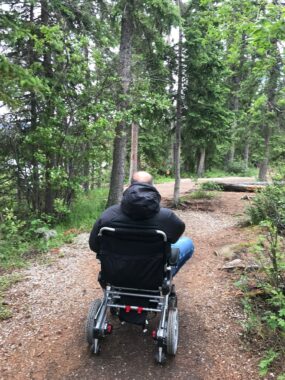
Jeff Sarnacki navigates a trail in Alberta, Canada, in June 2019. (Photo by Juliet Taylor)
The next summer, Jeff and I traveled with some of our best friends to Alberta, Canada. That adventure was among the trips I cherish the most from his time living with ALS, mostly for the sense of wonder and ability it brought him. While he could no longer walk, we’d pushed the limits of his electric scooter, inadvertently taking it off-roading along bumpy lakeside trails and later up a mountainside via a small, enclosed gondola. I’ve written before that Jeff asked to go whitewater rafting on that trip, and we found an outfitter willing to take him down relatively gentle rapids. I loved helping him find and participate in those adventures because it gave him the normalcy and independence we both so desperately wanted for him during his time with ALS.
Today, though, after walking that same beach from the birthday trip of long ago, I glanced through pictures on my phone. I remembered conversations, meals, and moments, musing on how easy and seamless the trip had felt, years before either of us really knew what ALS even was.
I reflected on how difficult, if not impossible, this trip would be while living with ALS. I thought about how hard travel can be with a power wheelchair; Jeff’s weighed 425 pounds even without him in it. I remembered the last trip we ever took together, driving from Maryland to Michigan in our mobility van, the packing list of medical supplies covering two single-spaced pages. I recalled the panic we experienced when his prescriptions were mixed up at the out-of-town pharmacy and we couldn’t reach anyone to correct the errors.
To be clear, neither the birthday trip nor the Alberta or Michigan trips was any less joyous than the others. We were in the company of people we loved, making memories and spending time together. But after living with Jeff’s ALS, I now notice ruefully the lack of curb cuts in many streets. I encounter broken airport elevators, blocked-in accessible parking, and dining tables that wouldn’t be able to accommodate a wheelchair. I notice, in a way that I wouldn’t have 10 years ago, a world that can be challenging or impossible for its citizens to navigate.
Many people living with ALS travel the world, taking in all the journey has to offer and continuing to expand their horizons and make memories with loved ones. Some have chosen to share their experiences, literally and figuratively, through social media or other means. Their adventures are important in showing that people with ALS and their families live full lives in the face of a disease that takes so much. And still, when it comes to accessibility, there is so much more to do.
It’s up to all of us to keep noticing and calling out barriers, to keep pushing and advocating for accessibility. When Jeff and I encountered accessible spaces, it brought him independence, safety, normalcy, and inclusion, to name just a few.
I miss Jeff on my trip this week; I miss him all the time. If he were still here today, still living with ALS, would we be able to do this same journey? While I wish the answer was yes, sadly, I’m not sure we could.
Note: ALS News Today is strictly a news and information website about the disease. It does not provide medical advice, diagnosis, or treatment. This content is not intended to be a substitute for professional medical advice, diagnosis, or treatment. Always seek the advice of your physician or other qualified health provider with any questions you may have regarding a medical condition. Never disregard professional medical advice or delay in seeking it because of something you have read on this website. The opinions expressed in this column are not those of ALS News Today or its parent company, Bionews, and are intended to spark discussion about issues pertaining to ALS.



Leave a comment
Fill in the required fields to post. Your email address will not be published.