Prevalence of ALS
 Fact-checked by
Amyotrophic lateral sclerosis (ALS) is a rare neurodegenerative condition, but the number of people living with it appears to be growing worldwide. Researchers believe this is partly due to an aging population, as well as improvements in diagnosis and treatments that allow people with ALS to live longer.
In ALS, the nerve cells that control muscle movement progressively die, leading to worsening muscle weakness and problems with movement, speech, eating, and breathing.
To understand the impact of ALS on populations and healthcare systems, scientists generally look at two distinct epidemiological measures:
- ALS prevalence, which refers to the total number of people living with ALS at a given time
- ALS incidence, which is the number of people newly diagnosed with ALS in a given period, usually one year
Tracking ALS incidence and prevalence helps scientists understand how common ALS is, identify trends over time, and estimate future healthcare needs. Understanding the true disease burden across geographical regions helps public health officials plan medical services and ensure adequate care and support services are available to the ALS community.
How many people have ALS?
While ALS is considered a rare disease, it is estimated that someone is diagnosed with ALS every 90 minutes. This means that thousands of people are diagnosed each year, and tens of thousands are living with the condition globally.
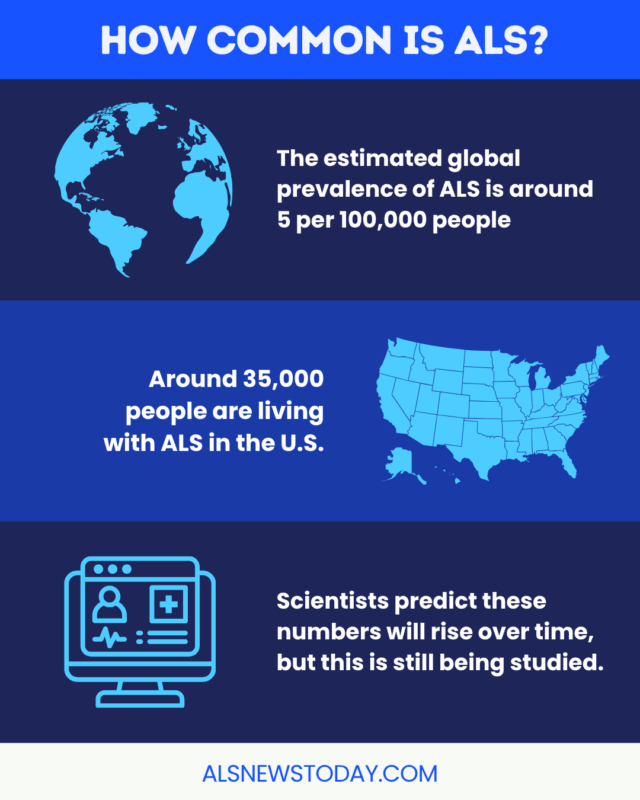
Current ALS statistics suggest that approximately 35,000 people are currently living with ALS in the U.S., with the ALS prevalence in the United States sitting at about 10.2 cases per 100,000 people. Each year, about 5,000 people are diagnosed with the disease nationwide, which corresponds to an ALS incidence of roughly 1.5 new ALS cases per 100,000 people per year.
A 2026 review study estimated the ALS prevalence worldwide to be about 5 per 100,000 people, although rates vary widely between countries. Europe, North America, and Oceania generally report the highest prevalence and incidence, while lower rates have been observed in many parts of Asia, Africa, and South America.
These ALS trends are evolving over time. Studies predict that the prevalence of ALS in several countries will increase by about 25% in the next 15 years. In the U.S., this means that almost 9,000 more people are expected to be living with the disease nationwide by 2040 compared with 2024.
This rise could be related to multiple factors, including an aging population that causes the number of new cases to increase and advances in ALS care that allow people with the disease to live longer.
Who is most likely to develop ALS?
ALS can develop in anyone, but it is more common in certain groups. Risk factors for ALS include:
- Age: ALS most often develops between the ages of 55 and 75
- Sex: ALS is about 20% more common in men than in women, although ALS incidence becomes more equal with increasing age
- Family history: Some genetic mutations that are inherited from a person’s biological parents can increase the risk of ALS
- Race and ethnicity: ALS incidence is highest in white people, particularly non-Hispanic white people, and lower in Black and Asian populations
Racial and ethnic differences are likely related to genetic factors that influence ALS risk, although disparities in environmental exposures, ALS diagnosis rates, and care access could also play a role.
Several other ALS risk factors have been identified, including smoking, toxin exposure, and a history of military service. Scientists are still working to understand these links and determine how these factors interact to influence the likelihood of developing ALS.
Why does ALS prevalence vary?
Many factors influence ALS prevalence, which is why estimates differ between countries and even between studies. Some factors that may affect ALS population statistics include:
- age of the study population
- race and ethnicity of the study population
- disparities in access to specialists, diagnostic equipment, treatment, and care
- regional differences in disease tracking and reporting
- advances in care and survival
Demographic factors, such as age and ethnicity, may affect the true number of people with ALS in a given area. Other factors may not affect how many people have ALS, but can influence reported rates of the disease.
For example, in areas with fewer specialists and diagnostic tools, the disease may be underdiagnosed. Some regions may also lack public health data systems capable of accurately tracking and reporting patients.
Access to treatment and care may also affect ALS epidemiology data. Better treatment can lead to higher survival rates, which in turn increases the number of people living with the disease.
How is ALS prevalence tracked?
Around the world, scientists rely on several resources to estimate the number of people living with ALS at any given time. These include:
- Population-based registries and national surveillance programs: Ongoing studies, such as the National ALS Registry, collect and store health information for all identified ALS cases in a geographical area.
- Administrative and insurance databases: Health insurance claims data, medical billing codes, and prescription records can help indirectly identify people seen or treated for ALS.
- Epidemiological studies: Large-scale studies, often conducted by public health organizations, can help track the ALS patient population over a set period of time.
Scientists combine information from these sources to estimate the prevalence of ALS and monitor trends over time. They can also use predictive modeling tools to estimate how prevalence will change in the future.
This information helps public health officials make informed decisions about ALS care ahead of time, but it’s important to understand that each of these sources has limitations, and the estimates they produce are educated ballpark figures, not exact counts.
As ALS research continues to improve and surveillance systems become more comprehensive, scientists expect future estimates to provide an increasingly accurate picture of how many people have ALS and how the disease affects populations worldwide.
ALS News Today is strictly a news and information website about the disease. It does not provide medical advice, diagnosis, or treatment. This content is not intended to be a substitute for professional medical advice, diagnosis, or treatment. Always seek the advice of your physician or other qualified health provider with any questions you may have regarding a medical condition. Never disregard professional medical advice or delay in seeking it because of something you have read on this website.