
Louis Matelski shares his journey and life with familial ALS, from noticing his first symptoms and receiving a diagnosis to finding treatment and maintaining hope for the future.
Transcript
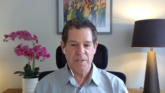
My name is Louis Matelski. I live in Cape Coral, Florida, southwest Florida, and I have three dogs and my wife. This is my 20th year down there. Originally from the northern part of the Lower Peninsula in Michigan, where I’m currently visiting family.
My journey with ALS, especially in the beginning, is probably a little different than most people. I come from a family that, unfortunately, has it run pretty deep.
I believe I’m like the 17th or 18th person to have gotten it. At the age of 40, I decided to do some stuff and really think about, “If it does happen to me, how am I going to prepare myself for it?”
So the biggest questions that I, after I got diagnosed, was more to do with the things that I can help do to prolong my life, the things that I can do to make the most of what I’ve got.
We had the S-O-D-1, the SOD1 defect in the gene, and there happens to be a medicine that’s currently out there to help slow it down. So once I learned about that, things really took off for me from there. But the beginning stages, it was a lot to kind of process and kind of figure out.
I was diagnosed in December of ’23, and it actually was the day after Christmas. It was Dec. 26, 2023. One day in, like, August, I was sitting on the couch. And I’ve always been able to, like, flex my calf muscles, like tighten them up and everything. And I noticed when I was sitting there that I couldn’t tighten up my left one. There was no response.
And I’m like, well, that’s weird. That’s not a normal thing because I could still do it on my right side, but not my left. By the end of September, no improvement whatsoever. And so that’s when I said to my wife, “Hey, I don’t want to freak you out, but I just want to let you know this is what’s going on.”
And she was like, “Well, with your family history, I would like for you to at least set up to see a neurologist by the end of the year.” Come December 26, that’s when she let us know that based on all the findings and everything, everything is pretty conclusive that it was ALS.
And within another six weeks after that, seven weeks after that, they had done the gene test to verify, and sure enough, it came back with the defect in the SOD1 gene. We immediately started all the medicine. And then, like I say, every 28 days, I go in for a spinal tap. And I get that done now.
So, and I’ve been holding steady, slightly regaining some control back in that left calf muscle. So there is some hope there.
I’ve been very lucky as well in terms of this because, again, I know a lot of people don’t have the support system that I have, and I’m, when it comes to a lot of, like, the questions and things, my aunt, my family, they’ve been there for me to be able to help me through a lot of that stuff.
Initially, what goes through your mind, obviously, is the end, right? You immediately jump to the end. And that’s a hard mindset to get past. But once you do get past it, I think the best advice that I had heard, I went to the ALS symposium. They brought up the fact that, you know, from the day that you’re diagnosed to your end date, you know, given the fact that there’s going to be one or whatever, there’s still a lot of time between. There’s still a lot of living that has to happen. There’s still so much that you’re capable of doing.
And that really stuck with me. And that’s one of those things where, you know, you just keep doing what you have to do. You know, that’s the biggest thing. And I’ve always been a very optimistic person, and I still am.
I think that when it comes to this particular disease, I, you know, I hope that they do create a cure for it. And I believe that if they do, I will be very lucky and be able to beat this thing. But that’s just the hope.
You still got to climb all the ladder, climb all those rungs of the ladder, and do what you have to do.