
MDA Engage: Event sessions highlight community, hope
Speakers emphasize connecting with community as a pathway to hope
Written by |
Two interconnected themes — community and hope — dominated the conversations at a recent gathering of people living with neuromuscular diseases.
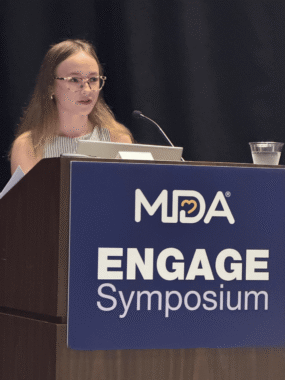
Lily Sander, MDA National Ambassador, speaking at MDA Engage: Dallas. (Photo by Tara Haelle)
Lily Sander, national ambassador for the Muscular Dystrophy Association (MDA), hit on those themes in the opening talk at MDA Engage: Dallas, an Oct. 23-24 symposium that brought together people living with neuromuscular diseases, their caregivers, clinicians, and advocates for support and education.
Sander, describing the journey from her first symptoms to being diagnosed with Charcot-Marie-Tooth disease, said the hardest part was the “unknown” and “the weight of carrying it all alone.”
So Sander and her family immersed themselves in community.
“We built support networks,” she said. “We met other families journeying the same path, and somewhere in that shared experience, we found hope.”
Sander did not sugarcoat the experience of living with a neuromuscular disease, acknowledging that there’s grief and struggle that others don’t always see. But she set the symposium’s tone for discovering hope through community.

‘Hope is the buzzword’ for treatments
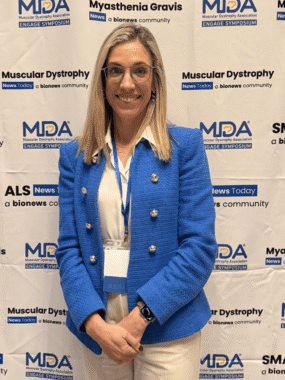
Kaitlin Batley, MD, a pediatric neurologist at Children’s Health and an assistant professor at UT Southwestern Medical Center, spoke at MDA Engage in Dallas. (Photo by Tara Haelle)
“Hope is the buzzword for today,” Kaitlin Batley, MD, director of the pediatric neuromuscular disease program at Children’s Health and assistant professor at UT Southwestern Medical Center, said in an interview with Bionews, the parent company of this site.
Batley, who gave a talk on spinal muscular dystrophy (SMA), said there has been “amazing success” with treatments for SMA, particularly for newborns treated before showing SMA symptoms. Their lives look dramatically different today than they might have a decade earlier, she said.
“I think that we’ve taken that hope, and … we’re extrapolating it to other disease states,” Batley said. “We’re using what we’ve learned in that space to apply to other therapies with other disorders … so whenever … there’s a success in the neuromuscular field for one condition, it’s a success for our whole field. It’s provided just a lot of hope moving forward that these therapies are coming for other disorders too.”
Batley said she hopes those attending left with a meaningful connection to someone else in the community and “just renewed sense of hope for themselves [and] their family members who might be living with these disorders that, even if there’s not a disease-modifying treatment right now, that hopefully it’s coming in the near future, and even if there’s not something that’s that close … there are other things that we can do to optimize care.”
The same energy was felt in a session about Duchenne muscular dystrophy (DMD) led by Aravindhan Veerapandiyan, MD, a pediatric neurologist known as Dr. Panda to his patients at Arkansas Children’s Hospital.
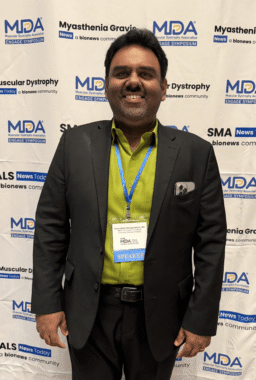
Aravindhan Veerapandiyan, MD, a pediatric neurologist at Arkansas Children’s Hospital, attended MDA Engage in Dallas. (Photo by Tara Haelle)
“I think we definitely we are in a much better place now from treatments and providing care for these individuals with DMD, even compared to three or four years ago,” Veerapandiyan said in an interview. He is particularly excited about the experimental therapy delpacibart zotadirsen (del-zota), which is under regulatory review in the U.S. to treat people with DMD who have certain mutations.
Veerapandiyan also said his wish for attendees was that they make connections.
“I want them to go home … knowing that there is a community that they could reach out to and there are people out there to help them and share their stories and experiences,” he said.
Daragh Heitzman, MD, director of the ALS clinic at Texas Neurology in Dallas, said this year’s meeting felt “much more optimistic” than past events he’s attended.
“It’s better from my perspective because I’m able to give hope, much more hope, and I can feel that I’ve got a pulse on what’s going on in research,” Heitzman said. “Just in one year to see what’s going on, the landscape keeps changing, [it] gets better and better.”
Haibi Cai, MD, an assistant professor at UT Southwestern Medical Center, who gave a talk on the transition from pediatric to adult care, also noted progress made in recent years.
“I think our overarching theme is that we are building more infrastructure for adult care multidisciplinary neuromuscular clinics,” a concept no longer limited to children’s care, Cai said in an interview. “As neuromuscular treatments get more and more effective, as quality of life improves,” he said, “it’s all the more important that we continue to provide the same level of care when these kids age out.”
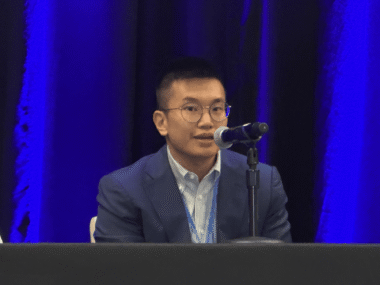
Haibi Cai, MD, assistant professor at UT Southwestern Medical Center, spoke at MDA Engage: Dallas. (Photo by Tara Haelle)
Cai said evidence shows that people with neuromuscular diseases do better when they attend a multidisciplinary care clinic instead of seeing individual specialists. While challenges to accessing those clinics remain, particularly for people living in rural areas, telemedicine has opened opportunities that weren’t available six or seven years ago, he said.
Attendees at this year’s event were very interested in clinical trials and the new genetic therapies becoming available, said Cai.
“I feel like that is definitely the area of neuromuscular [care] that we made most progress in the last few years, and … there’s a lot of exciting treatments and trials on the horizon,” he said. “I feel like the energy has been very positive, very hopeful, and I hope it continues.”
Cai said he’d like to see attendees continue advocating for themselves and taking ownership of their healthcare.

Hope through community
Patients also expressed hope for the future.
Sorayda Rivera, an advocate living with SMA type 3, highlighted the importance of community and the patient voice during the event’s closing panel.
“I don’t know where we would be today, or I would be today, if it wasn’t for people listening to our voice that we want treatments, we want a better quality of life,” Rivera said. “Now that more treatments are coming out … I feel like it’s getting more patients excited about what might come.” Advocates “are the ones that can really spread that information and really get people excited about the change that is coming because great things are happening and they’re already happening now,” she said.
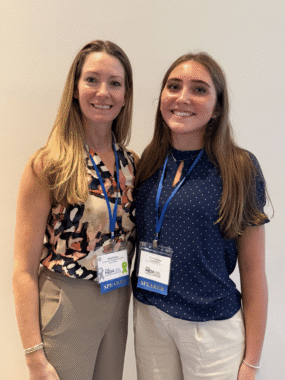
Kelly Brazzo (left) with her daughter Sammy Brazzo (right) attended MDA Engage in Dallas. (Photo by Tara Haelle)
Kelly Brazzo, whose daughter Sammy lives with limb-girdle muscular dystrophy type 2I/R9, urged clinicians to encourage their newly diagnosed patients to immediately connect with a patient advocacy group and learn all they can about their specific disease subtype, as many new treatments are gene-specific.
Treatments are on the horizon, said Brazzo, co-founder of CureLGMD2i. And in the meantime, “there are things you can do,” she said. “You can advocate for change on … Capitol Hill. You can share your story to spread awareness and … an understanding of the disease and the burden that it has, and be involved in change.”
Batley said her favorite part of MDA Engage events is hearing questions from attendees, talking about what’s important to them, and seeing people return.
“It’s been awesome to watch it grow, to watch word spread, to see even more families come out,” Batley said. “I always love seeing some of the older and adult patients get to connect with some of … [the] younger families [and] … the way that they guide each other.”
This year, Sander was doing some of that guiding, Batley said.
“Seeing what she has done for herself — she’s a college student who wants to be a lawyer, she’s amazing — and the difference she’s made, the advocacy, that’s what I’m hoping for for my patients,” Batley said. “I want all of them to say: ‘There is nothing that’s going to hold me back. I can do whatever I want to do when I grow up. I can go to college. I can have dreams and plans for the future.”
Note: The ALS News Today team is providing coverage of the MDA Engage Symposium. Go here to see the latest stories from the conference.


Leave a comment
Fill in the required fields to post. Your email address will not be published.