
MDA Engage: Early rehabilitation key for neuromuscular disease, experts say
They shared tips to help patients regain their mobility and independence
Written by |

Early rehabilitation, a care team that works together, and adequate bracing equipment can help people with neuromuscular diseases stay active and safe, two rehab specialists said.
“Every patient has a different journey,” said Sol Abreu-Sosa, MD, a physiatrist at Rush University Medical Center in Chicago. The exercise plan, equipment, or braces a patient receives, she said, “is never a one-size-fits-all.”
Abreu-Sosa presented the session, “Life, Your Way: Tools and Tips for Everyday Independence,” with Michael Elsen, a certified prosthetist and orthotist with Hanger Clinic in Chicago who works with Rush’s neuromuscular clinics. The session took place Sept. 26 during the MDA Engage: Chicago symposium.

Starting early
A physiatrist is a doctor who specializes in physical medicine and rehabilitation. They treat people with conditions that affect the brain, spinal cord, nerves, bones, joints, and muscles, such as amyotrophic lateral sclerosis (ALS). Their main focus is to help patients regain their mobility and independence.
“We don’t do any sort of surgical management, and we do things that include referring patients to undergo physical therapy, occupational therapy, or speech therapy. We might prescribe medications … [and] mobility equipment or devices,” Abreu-Sosa said.
For people with muscular dystrophy, who may experience problems with muscle strength, endurance, balance, joint stiffness, hand function, breathing, swallowing, and speech, the key “is just to do early rehabilitation,” Abreu-Sosa said.
Early therapy can catch changes in walking and balance, reduce falls, and teach people how to save energy. It also educates patients and families and gives them time to plan for changes in mobility.
Rehabilitation therapy can take place wherever it works best for the patient, whether that’s at home, in a clinic, or in the hospital.
Each treatment plan is built around the patient’s own goals. For one person, that might mean walking. For another, it might mean standing long enough to move into a wheelchair, or getting safely from bed to a shower chair.
Elsen, who also works closely with ALS patients, explained how the goals change depending on the patients’ abilities and the stage of the disease they are in. At an early stage, the goal is to keep patients “up and moving,” he said.
Later on, when a wheelchair becomes necessary, “if the patient is still standing and doing their transfers …, we always want the patient to be participating in these transfers as much as possible, but doing it safely,” Elsen said.
For people with ALS who are wheelchair-bound, the goals might shift away from trying to promote movement, and instead focus on preventing deformities or contractures, which happen when muscles, tendons, ligaments, or other soft tissues shorten and stiffen, limiting a joint’s range of motion.

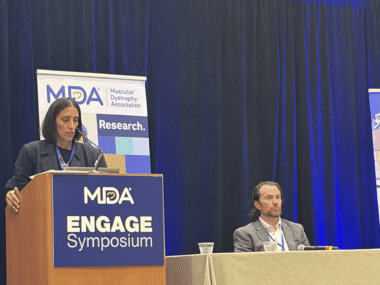
Sol Abreu-Sosa, MD, (left) and Michael Elsen made a presentation at MDA Engage. (Photo by Douglas Backstrom)
A team approach
Both Abreu-Sosa and Elsen work alongside a team of other specialists as part of rehabilitation therapy.
Abreu-Sosa’s team team includes therapists, nurses, social workers, psychologists, neuromuscular specialists, prosthetists, orthotists, and assistive technology providers who may offer assistance at wheelchair clinics and help with writing insurance letters.
Elsen also joins therapists in Rush’s MDA and ALS clinics to evaluate patients: seeing how they move, what their homes are like, whether they have participated in physical or occupational therapy, or used any kind of bracing equipment.
Braces that fit the goal
For patients with foot problems, Elsen suggests trying an insert from a running store first. If that doesn’t help, an orthotist can make a custom one.
For more support, orthotists design ankle-foot orthoses (AFOs), which fit in the shoe and up the calf. Some patients need knee-ankle-foot orthoses, which go up higher, sitting just below the knee. The technology keeps improving, Elsen said. Braces now come in plastic and lightweight carbon fiber, and some are 3D printed.
For people with Duchenne muscular dystrophy who are wheelchair-bound, a positioning AFO can keep ankle contractures from getting worse. Without a positioning AFO, the foot may turn inward over time, making it difficult for patients to put on shoes and clothes.
For people with Charcot-Marie-Tooth disease, who often have high foot arches and sprain their ankles easily, he recommends custom inserts in high-top shoes.
For people with ALS who can still stand and do wheelchair transfers, Elsen said he might help create an AFO that’s going to stabilize their ankles, so they feel more comfortable when transferring in and out of the wheelchair. For those who are wheelchair-bound, positioning braces may be used to help prevent deformities.
“When I’m designing these custom braces for positional purposes, typically I have to use different materials that are going to be a little more comfortable, and it’s going to be more total contact, so that I can control … [a] patient’s foot without creating sores,” Elsen said.
He recommended pairing any new brace with therapy so patients learn to use it and to put it on themselves. Children need regular refittings as they grow, while adult braces may last several years.
Paying for equipment
Insurers typically cover braces because they want to prevent costly falls, Elsen said. Medicare usually covers 80%, and secondary insurance may cover the rest. Elsen encouraged patients to lean on their care team. A prescribing doctor’s notes, for example, can help show an insurer why a brace is needed.
He also noted that there is a yearly $1,000 MDA grant that families can apply for to help pay for durable medical equipment.
Note: The ALS News Today team is providing coverage of the MDA Engage Symposium. Go here to see the latest stories from the conference.




Leave a comment
Fill in the required fields to post. Your email address will not be published.