
MDA Engage: ALS neurologist sees real reasons for renewed optimism
Daragh Heitzman shares how evolving research and clinics give families hope
Written by |

- Collaborative research and expanded access programs are speeding new treatments to patients faster than ever before, said Daragh Heitzman, MD, director of the ALS Clinic at Texas Neurology, at a recent MDA Engage event.
- Scientists are targeting the root biological causes of ALS, particularly toxic clumps of the TDP-43 protein found in most cases.
- Coordinated care at multidisciplinary clinics, weight maintenance, and noninvasive respiratory support can extend patient survival alongside approved treatments.
Scientists have been searching for a cure for amyotrophic lateral sclerosis (ALS) for more than a century, and they are making faster progress than ever before in today’s collaborative research environment, according to Daragh Heitzman, MD, director of the ALS Clinic at Texas Neurology in Dallas.
Heitzman, who has spent decades caring for people with ALS, recently discussed developments in ALS at the MDA Engage: Dallas symposium, including options for those who aren’t eligible to participate in clinical trials. The Oct. 23-24 event brought together people living with neuromuscular diseases and their caregivers, as well as clinicians and advocates, for education and community support. Heitzman’s talk, titled “ALS: Research and Cause for Optimism,” reviewed what researchers know about ALS and where science is advancing.
“I’m optimistic about the future,” he told Bionews, the parent company of this site, in an interview after his presentation. And those living with or affected by ALS “should be optimistic” too. Heitzman acknowledged the problem that the clock ticks down faster with ALS than for many other neuromuscular diseases, but there are also expanded programs getting experimental therapies to people faster as well, he said.

Understanding the biological causes of ALS
ALS is a progressive neurodegenerative disease that attacks the nerve cells that control muscle movements, called motor neurons. The destruction of motor neurons prevents the brain from sending movement signals to the rest of the body, so the muscles slowly stop functioning, weaken, and then begin to waste away.
One of the challenges with ALS is the mystery of what causes it. Researchers suspect the condition develops through a cumulative series of biological stresses or injuries over time, known as a “multi-hit” process. For individuals carrying certain genetic mutations, it may take fewer hits to trigger the disease. Although the idea that those hits must occur in a certain order to trigger ALS has been challenged, the general consensus is that ALS stems from an interaction among normal aging, inherited genetics, and environmental factors.
Scientists are trying to understand where precisely ALS starts in the body and whether a single common mechanism is responsible for it, because that would make it easier to find therapies targeting that mechanism. However, the fact that ALS presents differently in different people suggests that multiple factors and mechanisms may contribute to its development.
People with certain occupations, such as firefighters and those in the military, have a higher risk of developing ALS than others, Heitzman said. Other possible precipitating factors include trauma to the brain, observed in NFL football players and professional soccer players, as well as exposure to pesticides and lead, excessive exercise, and cigarette smoking.
Much of the current research focuses on a specific protein called TAR DNA-binding protein 43, or TDP-43. This protein normally stays within the nucleus of nerve cells, where genetic information is stored. However, in 97% of ALS patients, the protein escapes the nucleus and starts forming toxic aggregates that are believed to contribute to motor neuron degeneration. “And so, there’s research going on to modify that genetically with medicines to fix … TDP-43 in the cell,” Heitzman said.

Everyday management and approved treatments for ALS
Heitzman talked about the medications that are currently approved in the U.S. for ALS, but he also discussed what behaviors may help people with ALS live longer.
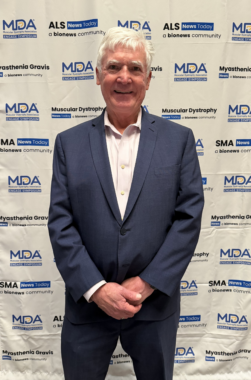
Daragh Heitzman, MD, is director of the ALS Clinic at Texas Neurology. (Photo taken by Tara Haelle)
“You live longer when you attend a multidisciplinary clinic,” Heitzman said, referring to specialized centers where patients receive coordinated care from neurologists, physical therapists, respiratory specialists, and dietitians during a single visit. People with ALS also do better when they maintain their weight, as avoiding weight loss correlates with better clinical outcomes.
Other factors linked to living longer with ALS include breathing exercises that improve breathing and swallowing, and using noninvasive ventilation devices, such as a CPAP machine, and cough assist devices that help clear mucus from the lungs. People can qualify for coverage of these devices after doing a pulmonary test. Those with Veterans Health Administration coverage can qualify at any time, but there may be a wait for those with Medicare.
In the U.S., Riluzole (sold as Tiglutik and generics in several formulations), edaravone (sold as Radicava ORS and generics in several formulations), and Qalsody (tofersen) are the three medications currently approved for ALS. The first two offer modest benefits, while Qalsody is specifically approved for people who have SOD1 gene mutations.
These therapeutic options reflect decades of sustained effort, Heitzman noted. “We know a lot more than in the past, [and] we’re learning more,” he said, adding that the goal has always been to offer patients hope that better medications and even a cure is coming. “That hope is now manifesting. It’s becoming real. The translation is happening, and we now [have] treatments because of effort, collaborations, science, and technology.”
Contrary to most of the times when I give an ALS talk … this year is much more optimistic. Just in one year to see what’s going on, the landscape keeps changing [and] gets better and better. There’s just so much more hope.
Working together for a cure
Heitzman said that ALS can only be cured if scientists and doctors understand it, and multiple initiatives are underway to do that. One of those is Answer ALS, which involves eight clinics across the U.S. Researchers collected clinical data and biological samples from more than 1,000 people with and without ALS to investigate the molecular and cellular mechanisms underlying the disease.
Another effort is PREVENT ALL ALS (NCT06581861), a long-term study of currently healthy people who have a genetic risk of developing ALS. By monitoring these participants over time, researchers hope to uncover the earliest biological markers of disease onset before physical motor decline begins.
Another development has been the creation of the HEALEY ALS Platform Trial (NCT04297683), which assesses the safety and efficacy of multiple experimental ALS therapies simultaneously, using a shared protocol and placebo group. This design can reduce the time and costs of clinical testing and help accelerate the evaluation of potential therapies, ultimately making new treatments available to patients sooner if they demonstrate benefit.
However, most people with ALS don’t qualify for clinical trials, Heitzman said, so Congress passed the Accelerating Access to Critical Therapies for ALS Act into law in 2021. The act authorized $500 million over five years to support research and development of new treatments for ALS and other rare neurodegenerative diseases. Just as importantly, it established a grant program supporting expanded access programs to investigational ALS therapies — basically “compassionate use,” Heitzman said — to help people who aren’t eligible for clinical trials access treatments before formal regulatory approval.
Heitzman mentioned other exciting research on ALS biomarkers, exploring how to harness artificial intelligence for ALS management, and even studies of “miniature” organ-like “brains” in space, where cells age rapidly, enabling faster understanding of the aging process.
“Contrary to most of the times when I give an ALS talk … this year is much more optimistic,” Heitzman said. “Just in one year to see what’s going on, the landscape keeps changing [and] gets better and better. There’s just so much more hope.”
Note: The ALS News Today team is providing coverage of the MDA Engage Symposium. Go here to see the latest stories from the conference.




Leave a comment
Fill in the required fields to post. Your email address will not be published.