
 Fact-checked by
 What is IPL344 for ALS?
IPL344 is being developed by Immunity Pharma as a possible treatment for slowing disease progression in people with amyotrophic lateral sclerosis (ALS).
ALS is a progressive neurological disease in which motor neurons, the specialized nerve cells that control voluntary movements, progressively die off, leading to worsening muscle weakness and other symptoms.
IPL344 is designed to prevent motor neuron death by activating the Akt signaling pathway, which helps protect nerve cells and regulate inflammation. That pathway has been found to have lower than normal activity in the nerve and muscle cells of people with ALS. By restoring the activity of this pathway, IPL344 is expected to help protect motor neurons and slow ALS progression.
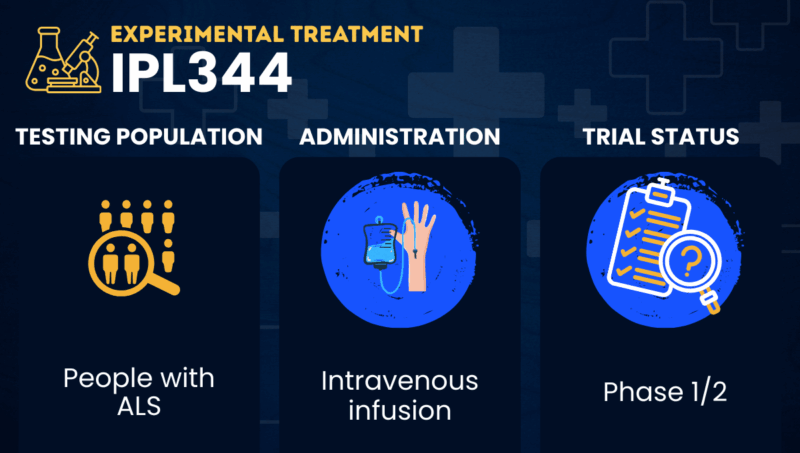
The therapy is being tested in ALS as an intravenous, or into-the-vein, infusion. It’s shown early signs of effectiveness in a Phase 1/2a clinical trial. The company has indicated plans for a larger, placebo-controlled trial to confirm these benefits.
Regulators in the U.S. and the European Union have granted IPL344 orphan drug status for ALS. That designation incentivizes the development of treatments for rare diseases, with market exclusivity should a therapy ultimately be approved.
Therapy snapshot
| Treatment name | IPL344 |
| Administration | Intravenous infusion |
| Clinical testing | Phase 1/2a testing complete |
How will IPL344 be administered in ALS?
In a Phase 1/2a ALS clinical trial, IPL344 was administered as a daily intravenous infusion. For most participants, the starting dose was 1.7 mg/kg, which was slowly increased to a maximum of 3.2 mg/kg based on individual tolerance to the medication.
The injections were given through a central venous catheter, a thin, flexible tube inserted into a large vein near the heart to make repeated infusions easier. Early infusions were administered by a healthcare provider, but family members or caregivers later performed the infusions at home using a specially designed electronic pump.
IPL344 in ALS clinical trials
A Phase 1/2a clinical trial involving dose escalation (NCT03652805) and long-term extension (NCT03755167) phases evaluated the safety and effectiveness of IPL344 in nine adults with ALS. The participants had relatively rapidly progressing disease, with a monthly decrease of at least 0.55 points on the ALS Functional Rating Scale-Revised (ALSFRS-R) in the time period leading up to the trial.
In the trial’s first part, the participants received daily IPL344 for 28 days, with the dose gradually increased as tolerated. In the second part, participants continued receiving their maximum tolerated dose of IPL344 for up to three years. The data showed benefits with treatment:
- The participants exhibited significantly slower disease progression relative to an external control group of placebo-treated patients from other ALS clinical trials, with a 64% slower decline in ALSFRS-R scores after adjusting for other variables.
- Body weight among participants was significantly preserved with IPL344 relative to the control group, with those treated gaining weight, on average, compared with the weight loss that tended to occur in the control group.
- IPL344-treated individuals survived a mean of about two years longer than the external control group and tended to see slower declines in respiratory function, although the differences did not reach statistical significance.
- Levels of neurofilament light chain, a molecular indicator of nerve damage, decreased by 27% in participants with available data.
As of early 2025, Immunity had suspended the clinical trial due to a shortage of IPL344. The company has indicated plans to initiate a larger, placebo-controlled trial to establish the therapy’s potential benefits in ALS.
IPL344 side effects
In the Phase 1/2a clinical trial, side effects that emerged with treatment included:
- pneumonia
- fall
- drug-related allergic reaction
Additionally, some participants experienced issues related to the central venous catheter, including itching, discharge, and fainting.
In one person who had an allergic reaction, including a rash and a rapid heart rate, side effects were successfully treated by changing the administration schedule and dose. Pneumonia was not considered related to the treatment in either of the two people who developed it.
ALS News Today is strictly a news and information website about the disease. It does not provide medical advice, diagnosis, or treatment. This content is not intended to be a substitute for professional medical advice, diagnosis, or treatment. Always seek the advice of your physician or other qualified health provider with any questions you may have regarding a medical condition. Never disregard professional medical advice or delay in seeking it because of something you have read on this website.